The nation
Stop treating nationalism as a sin. For Rubio, loyalty to your own nation is not selfishness.
 Es Posible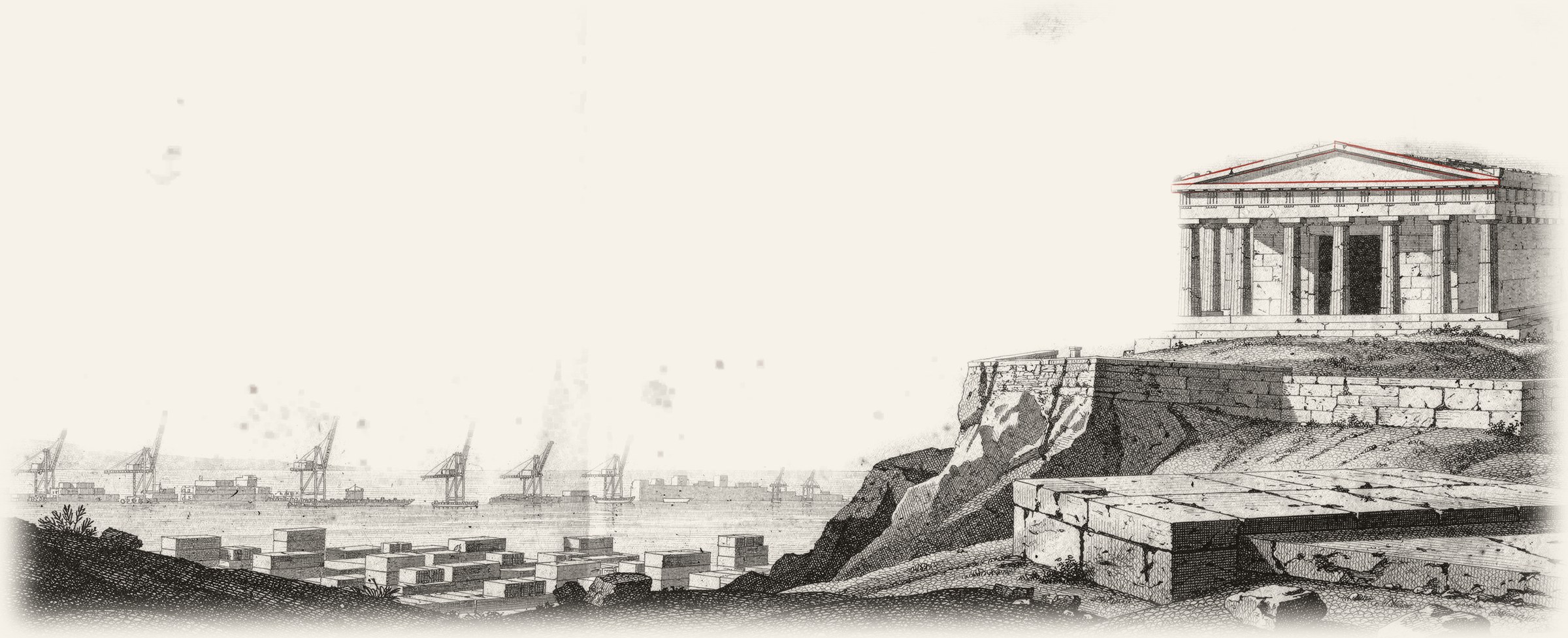
Renaissance or death of the West. The data decides.
Marco Rubio climbed the hill where Athens used to vote and gave the West ten years to decide whether it is reborn or fades out.
From that rock you can see the Parthenon. You can also see Piraeus, the port of Athens, two thirds of which belong to a Chinese state shipping company. The name Rubio never said is the one that decides the answer.
What is the real position of the West, and of the United States as Western civilization, against China and Eastern civilization?
I measured 29 public indicators of industry, energy, money, knowledge, talent, artificial intelligence and military power. The United States and the European Union together beat China on 15. The United States alone, on 9. That is the arithmetic behind the trip to Athens.
Short answer: the West is not dying, and it has not been reborn. It has the money, the currency, the markets and the compute for artificial intelligence. China has the matter: the factories, the steel, the ships, the robots, the electricity and, every year, more engineers and more patents. The century goes to whoever turns what they have into what the other one lacks.
Alone, the United States wins 9 of 29. With Europe, 15. Rubio did not go to Athens to give a history lecture. He went to recruit.
On October 7, 2026, as the sun went down, the U.S. Secretary of State spoke on the Pnyx, the rocky hill where Athenians gathered to vote. Above, the Parthenon. Below, the city. The setting was no accident: Rubio chose the birthplace of the assembly to say the West is at an inflection point, and that this point does not come twice.
The argument fits in three sentences. The West weakened itself: it turned nationalism into a dirty word, opened its borders, shipped its factories abroad and let its militaries rust. The United States has already chosen another path, the open, unapologetic pursuit of national power. And Europe can join if it wakes up from what he called a long slumber.
Then came the list, which is what a founder cares about. Take back critical supply chains. Reindustrialize the economy. Rebuild defense. Compete for the technologies and industries of the future, and he named them one by one: advanced manufacturing, drones, chips, minerals, cyber, energy. He closed with space and a return to the Moon.
Eight months earlier, in Munich, he had said something similar to Europe's leaders: shared heritage, pride without guilt, more defense spending. That time he got a standing ovation and, across the Atlantic, criticism from the left for his emphasis on faith and migration. In Athens he swapped the ballroom for a ruin and praise for a warning. The coming decade, he said, decides between power and decline.
And here is the interesting part. In the accounts of the speech, the word China does not appear. He spoke of supply chains, chips, minerals and great-power competition. All of that has one addressee. Rubio did not say it. The data does, and this essay puts it on the table.
Stop treating nationalism as a sin. For Rubio, loyalty to your own nation is not selfishness.
Take back critical supply chains and reindustrialize the economy.
Rebuild militaries that, in his words, were allowed to wither.
Compete in advanced manufacturing, drones, chips, minerals, cyber and energy.
Wake up, spend more on defense and make more things. He sees signs of a generational shift.
A new age of exploration: space and a return to the Moon.
Athens begins meeting on this hill to vote.
Greek learning travels to Italy and feeds the Renaissance.
The U.S. and Europe found the postwar institutions.
Publishes The Clash of Civilizations. Three years later, the book.
The mass move of factories to Asia begins.
China's state shipping company buys 51% of the port of Athens.
COSCO raises its stake with Greek parliamentary approval.
July: U.S. AI Action Plan. August: China's AI+ plan.
Rubio asks Europe for pride, defense and borders.
Rubio gives the West a decade to choose between power and decline.
Drag the timeline
“... nothing selfish or wrong about loyalty to your nation.Marco Rubio · The Pnyx, Athens, October 7, 2026
In the summer of 1993, Harvard political scientist Samuel Huntington published an essay in Foreign Affairs with a question mark in the title: The Clash of Civilizations? His thesis was simple and scandalous for its time. With the Cold War over, the great conflicts would no longer be between ideologies or economies, but between civilizations. He wrote that the fault lines between civilizations will be the battle lines of the future.
He drew the map: the West, the Sinic civilization with China at its center, the Islamic, the Hindu, the Orthodox, the Japanese, the Latin American and the African. Three years later he turned it into a book and went further. He said the West's relative power would decline. That China was the core state of Sinic civilization and that its economic growth would turn into cultural assertion and power.
And he left a prescription. The West should not try to impose its values on the rest of the world, because its civilization is unique, not universal. It should look after itself: bind North America to Europe, keep its technological and military edge, and control who comes in. The alternative, he warned, was the road to decline.
Read the Athens speech again with that prescription in hand. Pride in one's own heritage instead of guilt. The United States and Europe together. Factories, defense and technology under Western control. Borders. Rubio did not quote Huntington, but on the Pnyx he spoke like his most diligent student.
Where Huntington got it wrong was the weapon. He imagined a clash of identities and religions. Thirty-three years later, the clash with China is above all industrial and technological: it is fought in shipyards, rare earth refineries, chip fabs and data centers. Sinic civilization is not winning with Confucius. It is winning with steel, robots and electricity.
Huntington had fierce critics. In 2001 Edward Said answered that his thesis was a clash of ignorance and that civilizations are not closed blocs. He had a point: China buys Western technology, sells into Western markets and sends its best students to Western universities. But the Athens speech confirms that, in Washington, Huntington's diagnosis won the argument.
And there is a question Huntington left open that hits us head on. On his map, Latin America was a civilization of its own, a child of Europe but distinct from the West. Today America's top diplomat is the son of Cuban immigrants who speaks in the name of the West, and the reindustrialization he calls for needs a workshop next door. In the century of factories, civilization is no longer defined by faith alone. It is also defined by the supply chain you belong to.
| Huntington, 1993 and 1996 | Rubio, Athens, 2026 | |
|---|---|---|
| Identity | Western civilization is unique, not universal. | Pride in one's heritage, without guilt or apology. |
| Alliance | Bind North America and Europe. | Europe should wake up and join the United States. |
| Power | Keep the technological and military edge. | Rebuild defense and compete for the technologies of the future. |
| Borders | Control immigration. | The West weakened itself by opening its borders. |
| China | Core state of Sinic civilization, rising. | He did not name it. |
To measure whether the West is reborn or fading, epic speeches do not help. Counting does. I chose 29 public indicators from official and academic sources and put them in a single table. Each row says who is ahead.
Switch the view. With the United States and Europe together, the West wins by one. With the United States alone, it loses by eleven. That gap is the whole Athens speech.
How it is counted: the West adds the United States and the European Union when the figure can be added. When there is no EU figure, the European country used is shown, or the cell is left blank and marked with an asterisk (*). Analysis and educational tool built on public data; sources for every row are at the end.
Start with what you can touch. In 2025 China produced 27.4% of all the manufacturing value on the planet. The United States, 16.6%. The European Union, 17.2%. Together, the West still weighs a little more. But that tie in dollars hides an enormous gap in things.
Steel. China poured 960.8 million tonnes, 52% of the world. The United States, 82. Eleven and a half times. China's 2025 drop alone, about 44 million tonnes, equals half of everything the United States makes in a year.
Ships. In the first half of 2026 Chinese yards took about 72% of the world's new orders by tonnage. The U.S. commercial share in 2024 was 0.1%. That is not a gap. It is a different sport. And it is the sport that builds the hulls a navy depends on.
Robots. In 2024 China installed 295,000 industrial robots, 54% of the world total. That is twice what the United States, the European Union and Japan installed together. The country with the most workers is replacing them fastest, and not as a fad: it is running out of them. Its fertility rate is 1.01 children per woman.
Electricity, the variable nobody watches and the one that will decide artificial intelligence. China generated 10,578 terawatt hours in 2025, more than the United States and the European Union combined. In solar alone it added 315 gigawatts in one year, nine times what the United States added.
And underneath everything, rare earths: China mines 69% of the world's supply and refines about 85%. Rubio asked to take back minerals. He is right to ask. The question is how many years it takes to build a refinery, a shipyard or a steel mill. The honest answer: more than a term in office lasts.
“The West has the money. China has the matter. The century goes to whoever turns one into the other.Analysis · Simón Levy
Now flip the table. In money, the West is still another planet. The United States produced $30.8 trillion in 2025. The European Union, $21.2 trillion. China, $19.6 trillion. Measured by purchasing power, China is the largest economy, at $41.2 trillion. But purchasing power does not pay for oil in Rotterdam or chips in Taiwan.
The dollar is 56.7% of the world's central bank reserves. The euro, 20.6%. The yuan, 2.1%. In international SWIFT payments, the dollar carries 52%, the euro 21% and the yuan 3.3%. After twenty years of speeches about the end of the dollar, China has a currency almost nobody wants to hold.
Then there is the stock market. American companies are worth $68.9 trillion, 4.4 times Chinese ones. That is where the advantage that matters most in the AI race lives: the ability to pool hundreds of billions into a single bet, in a single quarter, without asking a party committee for permission.
But money comes with a bill. U.S. public debt is 123.9% of GDP and heading to 125.8%. China is at 99.2% and rising fastest: it projects 106.9% in a single year. Europe, 82.5%. The West has the cash. What it has not yet shown is that it knows how to turn it into factories.
| Indicator | U.S. | European Union | China |
|---|---|---|---|
| Nominal GDP 2025 | $30.8T | $21.2T | $19.6T |
| GDP at purchasing power 2025 | $30.8T | $29.4T | $41.2T |
| World reserves in its currency | 56.7% | 20.6% | 2.1% |
| SWIFT payments in its currency | 52.1% | 21.4% | 3.3% |
| Stock market value | $68.9T | approx. $13T | $15.5T |
| Public debt, % of GDP 2025 | 123.9% | 82.5% | 99.2% |
If money is the present, patents are the future written in small print. And by volume, the future is already written in Chinese.
In 2025 China filed 73,718 international patent applications under the PCT treaty. The United States, 52,617, down 3%. Germany, 16,441. The world's biggest filer is Huawei, with 7,523, more than twice Qualcomm, the first American on the list. In fifth place is CATL, the Chinese battery maker.
At home, the gap is brutal. China's office received about 1.8 million patent applications in 2024, three times the U.S. office and nine times the European one. In industrial designs, the property that protects how a product looks and works, China holds 52.9% of the world: 825,330 filings against 68,575 in the United States.
The Nature Index, which counts science published in the top journals, gives China 52,735 points and the United States 26,006: double. The Australian institute ASPI's Critical Technology Tracker found China leads research in 66 of 74 critical technologies. The United States, in 8.
Careful reading this as defeat. Volume is not quality. In research spending China barely passed the United States, $1,028 billion against $1,009 billion in purchasing power, and the U.S. invests a bigger slice of its economy: 3.44% against 2.69%. Europe sits at 2.13%. Among the 100 most cited AI papers of 2024, 46 are American and 41 Chinese. America still writes the best sentence. China already writes almost all the others.
Civilizations are not saved by speeches. They are saved by engineers. And there, China's numbers are frightening.
In 2020, the latest year with an international comparison from the U.S. National Science Foundation, China awarded 1,975,602 university degrees in science and engineering. The United States, 898,973. One in three Chinese degrees is in engineering; in the United States, fewer than one in twelve. China has 3.18 million full-time researchers. The European Union, 2.18 million. The United States, 1.73 million.
In PhDs, the 2020 tie, 43,399 against 41,701, is already gone. Georgetown University's CSET projected that from 2025 China graduates more than 77,000 science and technology doctors a year, almost twice the United States. Without the foreign students at American universities, the ratio would be more than three to one.
But one figure flips the table. China's working-age population lost 8.2 million people between 2015 and 2025. Europe's lost 5.2 million. America's gained 6.5 million. China's fertility rate is 1.01; Europe's, 1.34; America's, 1.63. China has today's engineers. America has tomorrow's workers.
And a warning that makes the speech itself uncomfortable. According to Stanford's AI Index, the flow of AI talent into the United States has fallen 89% since 2017, and 80% of that drop happened in the last year. Closing borders protects wages. It can also close the door through which the minds that built Silicon Valley came in.
If there is one field where Rubio has reason for optimism, it is this one. And even here the lead is shrinking faster than Washington admits.
In 2025 private AI investment in the United States reached $285.9 billion, 23 times China's $12.4 billion and almost fourteen times Europe's. The United States produced 59 notable models; China, 35; Europe, 2. The four big American tech firms spent about $400 billion on infrastructure in 2025 and are heading toward about $600 billion in 2026. The Chinese ones, around $100 billion.
Compute is the moat. The United States holds about 75% of the world's AI supercomputer capacity; China, about 15%. Huawei's Ascend chips amount to less than 4% of Nvidia's AI compute. Washington keeps the most advanced chips blocked, and in January 2026 it opened case-by-case review for the H200, with a 25% charge. Beijing responded by asking its companies to pause purchases.
Now the other side. With 23 times less private money, the best Chinese model came within 2.7% of the best American model on the LMArena ranking in March 2026. In 2023 the gap was between 17 and 31 points. China holds 74.2% of AI patents granted in 2024, and its open models, like Qwen and DeepSeek, are already 41% of downloads on Hugging Face. Epoch AI also estimates that about a third of the AI compute in China was smuggled in.
In the physical side of AI, China has already won the first round. Of the roughly 13,000 humanoid robots sold worldwide in 2025, the top three makers, all Chinese, delivered about 10,400.
Both governments already read this as a state race. Washington published its AI Action Plan in July 2025 and launched the Genesis Mission in November, presented as a new Manhattan Project. Beijing approved its AI+ plan in August 2025, aiming for more than 90% of its economy to use AI agents by 2030. Alibaba was the first major company to make superintelligence an explicit goal. America is winning the race for the brain. China is pulling ahead in the race for the body.
| AI indicator | U.S. | China | Europe |
|---|---|---|---|
| Private investment 2025 | $285.9B | $12.4B | $20.9B |
| Notable models 2025 | 59 | 35 | 2 |
| AI compute | ~75% | ~15% | marginal |
| Gap to best model, Mar 2026 | reference | -2.7% | n/a |
| AI patents granted 2024 | 12.1% | 74.2% | 3% |
| Most cited AI papers 2024 | 46 of 100 | 41 of 100 | n/a |
| Open-model downloads | overtaken | 41% | n/a |
| Infrastructure spending 2026 | ~$600B | ~$100B | n/a |
Rubio set a deadline: the next ten years. This calculator tests whether that is enough. Pick an indicator, move each side's annual growth rate and see in what year the curves cross, if they cross at all.
The preloaded rates are illustrative assumptions, not forecasts. The point is to see what would have to happen for the West to catch China where it trails, or for China to catch the West where it leads.
Analysis and educational tool. Starting point: latest official figure for each indicator (see sources). Growth rates are assumptions the reader sets.
Back to the Pnyx. From there, looking southwest, you can see Piraeus, the port that has fed Athens since Themistocles walled it twenty-five centuries ago. Today 67% of its port authority belongs to COSCO, China's state shipping company.
COSCO bought 51% in 2016 and went to 67% in 2021, with approval from the Greek parliament. Greece needed money after its debt crisis and Europe did not put it up. China did. The port grew and became one of the main gateways for Chinese goods into the Mediterranean.
That is why the silence in the speech weighs so much. Rubio called for taking back supply chains from a hill that overlooks one of them in Beijing's hands.
Mexico has its own Piraeus. Hutchison Ports, part of Hong Kong's CK Hutchison group, runs two terminals in Lázaro Cárdenas that moved about 60% of that port's containers in 2023, plus two more in Ensenada. CK Hutchison agreed to sell 43 ports in 23 countries to a BlackRock and MSC consortium. In January 2026 the sale was stuck: COSCO was demanding a majority stake.
If that sale ends with COSCO as majority partner, Mexico's main Pacific port would be tied to the same company that controls the gateway to Athens. It is a scenario, not a done deal. But it is exactly the kind of supply chain Washington says it wants back, and the kind of file that can be brought for review before U.S. foreign investment and trade authorities.
A serious essay does not do anyone's propaganda. These are the weaknesses each power prefers not to mention.
The conclusion is comfortable for no one. China builds faster than it can pay and ages faster than it can automate. The West pays more than it builds and argues more than it trains engineers.
Every reader has an idea of what decides a century. Some say money, some the factory, some artificial intelligence. This balance lets you choose. Move the weight of each pillar and watch where it tips.
With every pillar at the same weight and Europe on America's side, the result is a statistical tie with a slight Western edge. Take Europe out and the balance tips toward China. That is the calculation Rubio took to Athens.
Analysis and educational tool. Each pillar averages the West's share versus China across its scoreboard indicators. It is not a forecast: it is a way to rank public data by what the reader considers important.
Six readings to decide where to put capital, factories and people in the decade Rubio called decisive.
If the West wants to reindustrialize, money is not what is scarce. Factories, robots, steel and electricity are. Whoever supplies them to North America gets paid a premium.
China generates more electricity than the U.S. and Europe combined. AI runs on electrons. Generation, grids and storage are the bottleneck.
The speech calls for supply chains under Western control. Mexico is the natural workshop for that reindustrialization, as long as it proves origin and security.
Chinese components, ports with Chinese state partners and origin transshipment will be reviewed. Document your chain before someone else does.
America's edge is models and compute; China's, robots and hardware. Integrating both in manufacturing inside North America is an open opportunity.
The West's real shortage is engineers. Training, attracting or keeping them will be one of the businesses of the decade.
Speech: October 7, 2026 coverage by The Times of Israel, KLIF, Townhall and The Washington Post; Greek City Times preview with a State Department statement. Munich: speech of February 14, 2026, White House and Rasmussen Reports.
Industry: World Bank (manufacturing value added); BEA via FRED (U.S.); worldsteel (2025 steel); IFR World Robotics 2025; CSIS and Clarksons via Maritime Executive (ships); USGS Mineral Commodity Summaries 2026 (rare earths); IEA (refining).
Energy: Ember, Global Electricity Review 2026. IEA, Global EV Outlook 2026.
Money: IMF World Economic Outlook April 2026 and COFER (Sep 30, 2026); SWIFT Global Currency Tracker (Aug 2026); World Bank and CEPS-ECMI (stock markets).
Patents and science: WIPO PCT Yearly Review 2026 and World IP Indicators 2025; Nature Index Research Leaders 2026; ASPI Critical Technology Tracker (Dec 2025); OECD MSTI (R&D and researchers).
Talent: NSF Science and Engineering Indicators 2024; CSET Georgetown (2021); World Bank (fertility and population 15-64).
AI: Stanford HAI AI Index 2026; Epoch AI; IEA Energy and AI; WIPO (generative AI patents); Hugging Face; Omdia (humanoids); Covington, TechPolicy.Press and KrASIA (state plans); BIS (export controls).
Power: SIPRI (2025 military spending); Congressional Research Service and Department of Defense (ships).
Ports: COSCO and Piraeus Port Authority via Port Technology and Seatrade Maritime (51% in 2016, 67% in 2021); CSIS, Apr 2025 (Hutchison terminals in Mexico); India Seatrade News, Jan 2026 (CK Hutchison sale).
Huntington: Samuel P. Huntington, "The Clash of Civilizations?", Foreign Affairs, Summer 1993, and The Clash of Civilizations and the Remaking of World Order (1996). Edward Said, "The Clash of Ignorance", The Nation, October 2001.